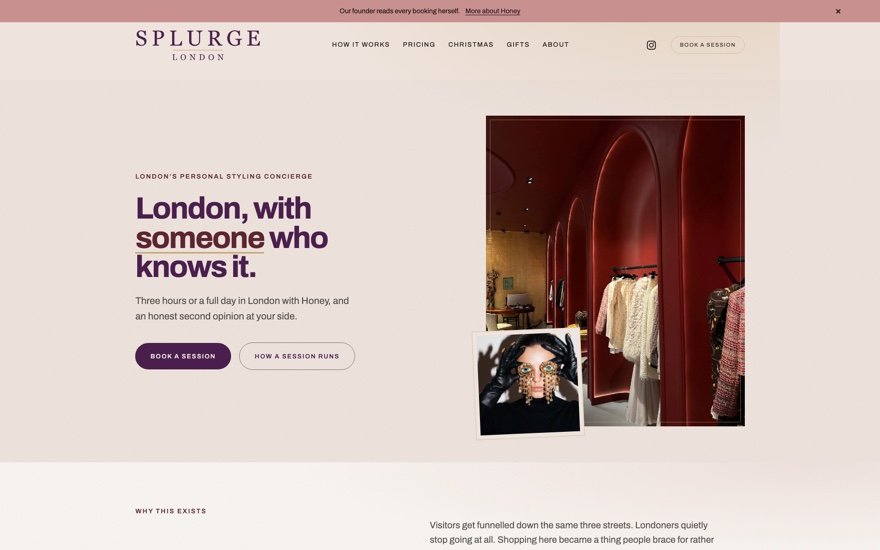
A personal styling concierge in London, sold end to end on her own site. Live availability, card payment taken on the page, and a calendar she controls herself.
Asquare AI built Splurge London a site that does the whole job: shows real availability, takes the booking, and charges the card on the page rather than handing the customer to somebody else's checkout. Behind it sits a calendar screen the owner runs herself, so she can block a day, take a booking by phone or pause entirely without ever opening a payment dashboard.
Splurge is a personal shopping and styling concierge in London: three hours at £250, a full day at £450, spent walking the shops with an honest second opinion at your side. It is a one-person business, which is the whole appeal and also the whole problem.
Enquiries do not arrive during office hours. They arrive late in the evening, when someone has a wedding in three weeks and nothing to wear. A contact form that sits unanswered until morning loses that person, because by morning they have found somebody else.
Most small service sites hand the customer to a third-party booking tool at the exact moment they decide to commit. The page changes, the branding changes, and a good proportion of people quietly stop. We kept the whole thing in one place.
Booking systems are usually sold on the customer-facing calendar. In practice they are abandoned because of the back office: the owner cannot block a holiday, cannot enter the booking that came in by phone, and ends up keeping a second diary on paper. Within a month the website's calendar is wrong and nobody trusts it.
So the admin screens got the same attention as the public pages, and every rule she sets there folds into the single function the customer calendar, the booking form and the payment check all read. There is no second set of rules to drift out of step.
Related services: website development · web design in Essex
On its own site, whenever the service is the brand. Sending someone to a third-party checkout at the moment they commit is where bookings leak, because the page suddenly looks like somebody else's. Taking the card on your own page keeps the whole decision in one place, and you keep the customer relationship rather than renting it.
If enquiries arrive outside working hours, yes. The alternative is a form that sits unanswered until morning, by which point the customer has booked someone else. The important part is that the owner can still block out days, take bookings by phone and pause entirely, so the system serves them rather than the other way round.
A service site with real availability and card payment typically runs from around three thousand pounds, against a few hundred for a brochure site. The difference is the booking logic, the payment integration and the admin screens the owner actually uses. It pays back quickly if it captures the enquiries that currently arrive at ten at night.
If people are enquiring in the evening and booking someone else by morning, that is a booking problem, not a marketing one. We build service sites that take the booking and the payment while the customer is still interested.
Book a free strategy call →